
Scandals & Feuds · 2010s
The Dez Bryant Catch Reversal and the NFL’s 2018 Catch-Rule Revision
On January 11, 2015, a replay review overturned Dez Bryant’s apparent fourth-down reception at Lambeau Field, giving Green Bay possession and a 26–21 victory over Dallas. The play later became one reference point in the NFL’s revision of its catch rule, which required a receiver to establish himself as a runner after controlling the ball.
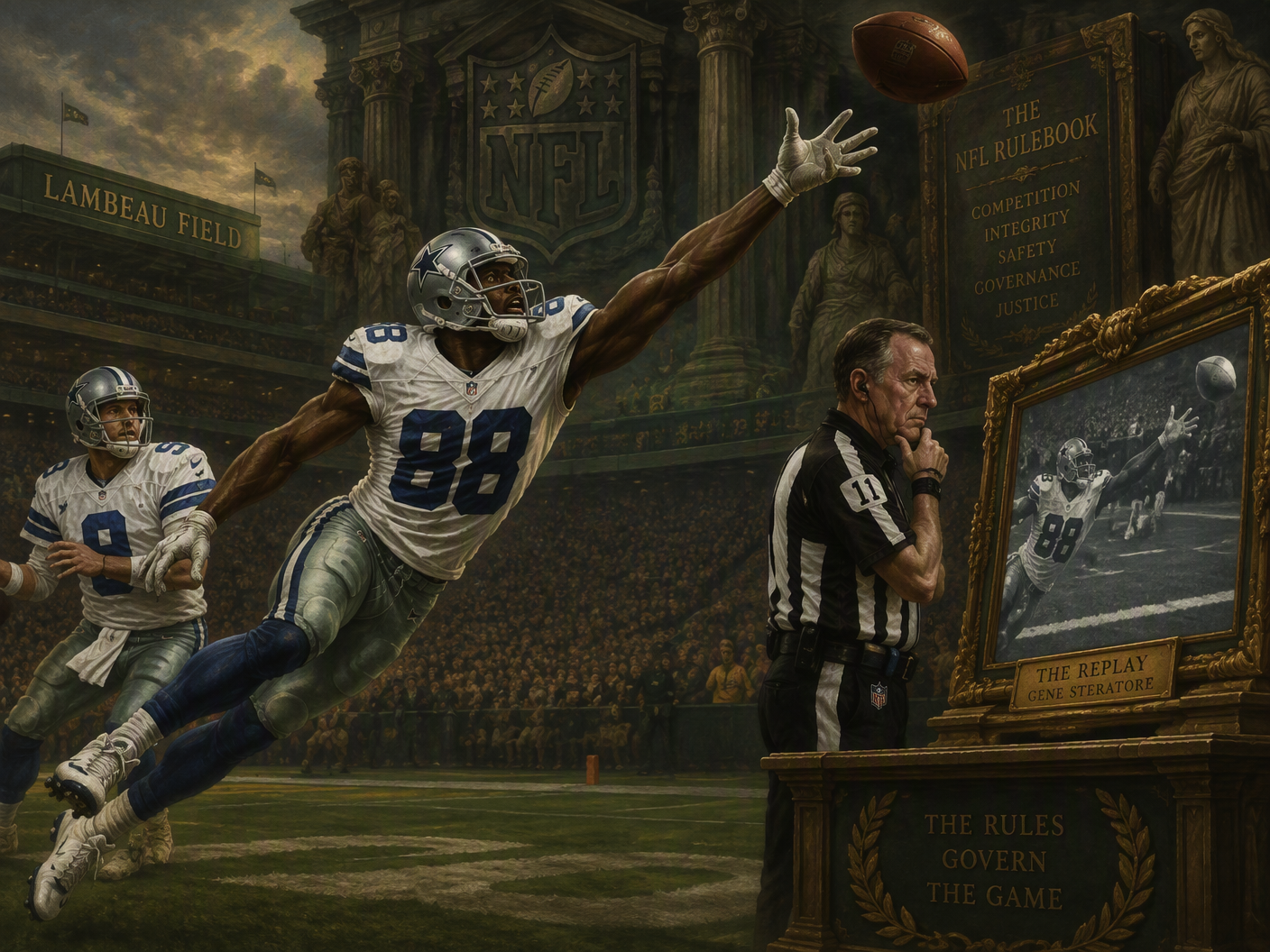
Dez Bryant’s reception became a turnover with 4:42 left in the fourth quarter. The Dallas Cowboys wide receiver had been the target of Tony Romo’s pass on fourth-and-2 against Green Bay at Lambeau Field. The on-field ruling awarded Dallas a completion. Replay review reversed it. Green Bay received possession, and the Cowboys’ drive ended not with another chance but with a change of ownership. In a playoff game decided by five points, the decision moved from an official’s judgment to a league-governed conclusion in the space between the field and the replay screen.
The game belonged to the 2014 NFC Divisional Playoff, but its argument outlived the season. Dallas had reached the most consequential part of the afternoon, where fourth down strips away the ordinary margin for error: gain the required distance and continue, fail and surrender the ball. Bryant’s catch sat directly inside that boundary. The call did not merely measure what happened to the football; it determined which team could act next. For the players, the rule was a working condition of the contest, enforced in real time and then reconsidered by officials away from the play.
Replay gave the league a second form of authority. The officials’ original ruling had treated Bryant’s effort as a reception. After review, they applied the catch standard differently and overturned the decision. That reversal fixed the play’s meaning for the game, regardless of how clearly the motion had appeared to the people watching it unfold. A receiver could secure the ball, land inbounds, and still have the classification of the play depend on whether he had completed the required act before the ball moved. The distinction belonged to the rulebook, but Bryant carried its consequence.
Green Bay retained possession after the reversal and closed out a 26–21 victory. The final score gave the decision a permanent place in the game’s outcome: Dallas could not regain the ball, and Green Bay no longer had to defend that fourth-down situation. Bryant’s reception became the hinge because the ruling altered possession at the point when possession mattered most. Romo’s pass, Bryant’s contested catch, and the officials’ review became one sequence, even though each part belonged to a different layer of professional football—execution by players, interpretation by officials, and final authority held by the league.
The dispute that followed did not change the score. It did change the language used to describe what a catch required. The play was remembered as a question about whether Bryant had completed the act of receiving the ball or had remained subject to another condition while going to the ground. That question placed an unusually technical burden on an ordinary football action. The athlete’s body moved through the play in one continuous effort; the rule separated that effort into control, contact with the ground, and the transition from receiver to runner.
That separation mattered because professional football is governed through written standards as much as through athletic performance. A receiver’s split-second movement can determine a team’s travel schedule, postseason revenue, employment narratives, and public standing, while the player has no authority to revise the definition being applied. Bryant was asked to perform under a standard that officials could revisit after the fact. Dallas absorbed the immediate cost in the form of lost possession and elimination from the game; the league absorbed a different cost, as the catch rule became harder for players and viewers to understand.
Between 2015 and 2018, the NFL revised its catch rule. The later language required a receiver, after controlling the ball, to establish himself as a runner. Two feet inbounds remained part of the test, but the wording placed greater emphasis on what happened after control: whether the receiver had completed the process of becoming a runner rather than remaining in the act of catching. Bryant’s play stood among the high-profile catch controversies that gave the revision its public meaning. The league did not erase the Lambeau ruling; it changed the terms future rulings would use.
Rule changes rarely reach the field as abstract policy. They arrive in the hands of receivers, quarterbacks, defensive backs, coaches, and officials who must convert sentences into decisions before the next snap. A phrase such as “establish himself as a runner” carried practical consequences for the people whose jobs depended on those decisions. It offered a different framework for judging control and movement, while preserving the need for two feet inbounds. The public argument surrounding Bryant’s catch therefore entered the workplace where every Sunday interpretation could affect a player’s statistics, team’s possession, and season.
The same rivalry supplied another late-game scene two years later. On January 15, 2017, the Packers and Cowboys met again in the 2016 NFC Divisional Playoff, this time at AT&T Stadium in Arlington, Texas. Aaron Rodgers led Green Bay, and his third-and-20 pass to Jared Cook extended the Packers’ position deep into the closing sequence. Mason Crosby then kicked the game-winning field goal as time expired. The moment did not settle the earlier Bryant ruling, but it gave the rivalry another ending shaped by possession, interpretation, and a final decision made under the clock.
For Dallas, the Lambeau play remained attached to the narrowest margin in football: one ruling, one lost possession, one opportunity that could not be recovered. For the league, it became part of a longer administrative process in which contested catches accumulated pressure for a new standard. Bryant’s name remained connected to the old wording because his effort had been placed at its most consequential edge. The 26–21 result stayed fixed, while the rule moved forward. What the Cowboys carried away was a defeat; what the NFL carried forward was a revised definition of when a receiver’s work was finished.
Investigative Dossier & Evidence
Read the companion investigation notes, verified source claims, and primary documents.
Read the Companion Notes & Evidence Record →