
Tragedy · 2010s
Dave Duerson’s Suicide and the Brain Sent to the NFL Bank
Dave Duerson died by suicide in Florida on February 17, 2011, after asking that his brain be donated to the NFL’s brain bank. The postmortem examination found advanced CTE, including tau accumulation and shrinkage across multiple brain regions, placing one athlete’s decline inside a wider public-health story about repeated head trauma.
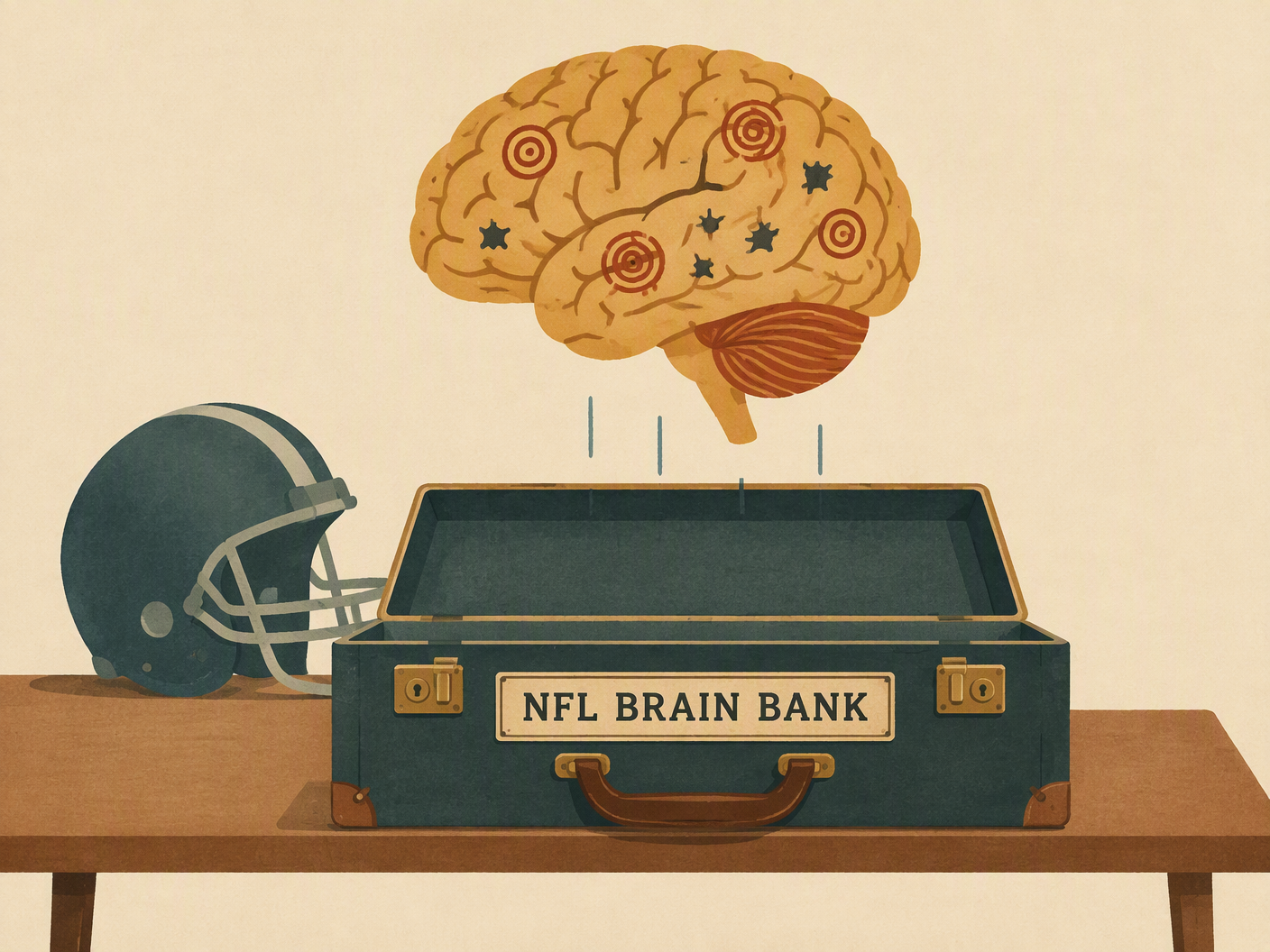
On February 17, 2011, Dave Duerson died by suicide inside his Florida apartment. He was 50. He had shot himself in the heart. Before his death, he asked that his brain be sent to the NFL’s brain bank. The former safety had played 11 seasons for the Chicago Bears and New York Giants, in a profession that measured toughness in collisions and availability. The gunshot ended his life. The request moved what followed from a Florida apartment to a research setting, where the body gave up an answer the man could not.
Duerson’s family recalled at least 10 concussions during those 11 NFL seasons. The number belonged to family memory, not a complete ledger of every hit or examination. It was still part of the account they carried after his death. Duerson had been a safety, a player positioned to meet runners and receivers at speed, then rise and line up again. The work left no neat border between a Saturday injury and the years that followed. His career ended. The consequences did not arrive on a schedule anyone could see.
Memory loss, depression, violent mood swings, and other cognitive and behavioral problems are associated with CTE. Before Duerson died, Alicia described changes that had entered ordinary life: memory lapses, mood swings, headaches, blurred eyesight, and a business in decline. These were not statistics from a study. They were the conditions surrounding a former professional football player as his work, health, and relationships lost their old shape. The symptoms accumulated over years, in Florida and elsewhere, while the public image of the player remained easier to recognize than the man inside it.
In February 2005, authorities charged Duerson with assault after an alleged attack on Alicia in an Indiana hotel room. The charge placed violence inside the private life that had been kept separate from football’s public value. Alicia was not describing a bad game or a difficult season. She was describing an encounter that brought police and criminal law into the hotel room. The assault remained an allegation, while the charge itself became one of the documented points along the road from Duerson’s playing career to the final years of his life.
Alicia also relayed Duerson’s request about his brain. It was a specific instruction, made before the final act and directed toward what would happen afterward. He wanted the tissue studied by the people building a medical picture of repeated head trauma in football. That decision gave researchers access to the organ that carried the history of his career. It also left his family with a task no team trainer, league official, or former teammate could perform for them: deliver the brain to the bank and wait for an answer.
At Boston University, neuropathologist Dr. Ann McKee examined the donated brain. The examination found advanced chronic traumatic encephalopathy. It also showed tau accumulation and shrinkage in multiple areas of the brain. Tau is part of the pathology associated with damaged nerve cells, and the distribution mattered to the diagnosis. Duerson’s name was no longer attached only to tackles, championships, or a uniform number. His brain had become a specimen in the growing study of what repeated football collisions could leave behind after the applause, contracts, and cameras were gone.
The diagnosis supplied a medical vocabulary for the changes Alicia had described, but it did not turn a complicated life into a single sentence. Memory lapses could be seen. Mood swings could be felt by the people around him. Headaches and blurred eyesight could interrupt a day. Advanced CTE was found after death, in tissue removed from the man who had experienced those years. The pathology named disease inside the brain. It could not reconstruct every decision, every conversation, or the private distance between decline and the gunshot in Florida.
On September 6, 2012, occupational epidemiologist Everett Lehman summarized a cohort study of retired NFL players. The study found that their overall risk of death associated with neurodegenerative disorders was three times higher than in the general United States population. For deaths associated with Alzheimer’s disease and ALS, the risk was four times higher. Those figures did not belong to one apartment or one family. They widened the frame around Duerson’s brain, placing his postmortem diagnosis beside a population-level pattern that public-health researchers were beginning to measure.
By July 28, 2017, former New York Jets defensive back Jim Hudson had also been diagnosed with CTE. The public discussion included former players such as Hudson and Kevin Turner, and families describing memory loss, depression, violent mood swings, and other changes after football. Duerson’s case remained central because his brain had been deliberately given to researchers and found to contain advanced disease. The study of former players was no longer confined to injury reports from the season. It had moved into mortality tables, family testimony, and laboratories handling tissue from men who were gone.
Duerson’s suicide and the examination of his brain were connected by his final request, not by a sentence written after the fact. The tissue showed advanced CTE. It did not supply a motive, a confession, or an official explanation for why he pulled the trigger. The old assault charge stood as an allegation, not a conviction. The concussion count came from family recollection. Each fact had its own weight. Together they described a life under pressure without giving anyone permission to invent the missing pieces.
Duerson had asked the NFL’s brain bank to keep looking after he was dead. Researchers did. They found tau accumulation and shrinkage across multiple regions, a diagnosis advanced enough to change how his final years were discussed. The finding entered the wider argument over football, mortality, and responsibility. It did not return him to the Florida apartment, restore the business that had declined, or let him answer for the years Alicia had described. The brain bank received what Duerson asked it to receive. He was not there for the answer.
Investigative Dossier & Evidence
Read the companion investigation notes, verified source claims, and primary documents.
Read the Companion Notes & Evidence Record →