
Violence & Brawls · 1990s
Dale Hunter’s Late Hit and the 21-Game NHL Suspension
After Pierre Turgeon scored the series-clinching goal for the New York Islanders on April 28, 1993, Dale Hunter struck him late and injured his shoulder. The NHL answered in October with a 21-game suspension, a punishment that followed Hunter into the next season and hardened his reputation as one of hockey’s most aggressive players.
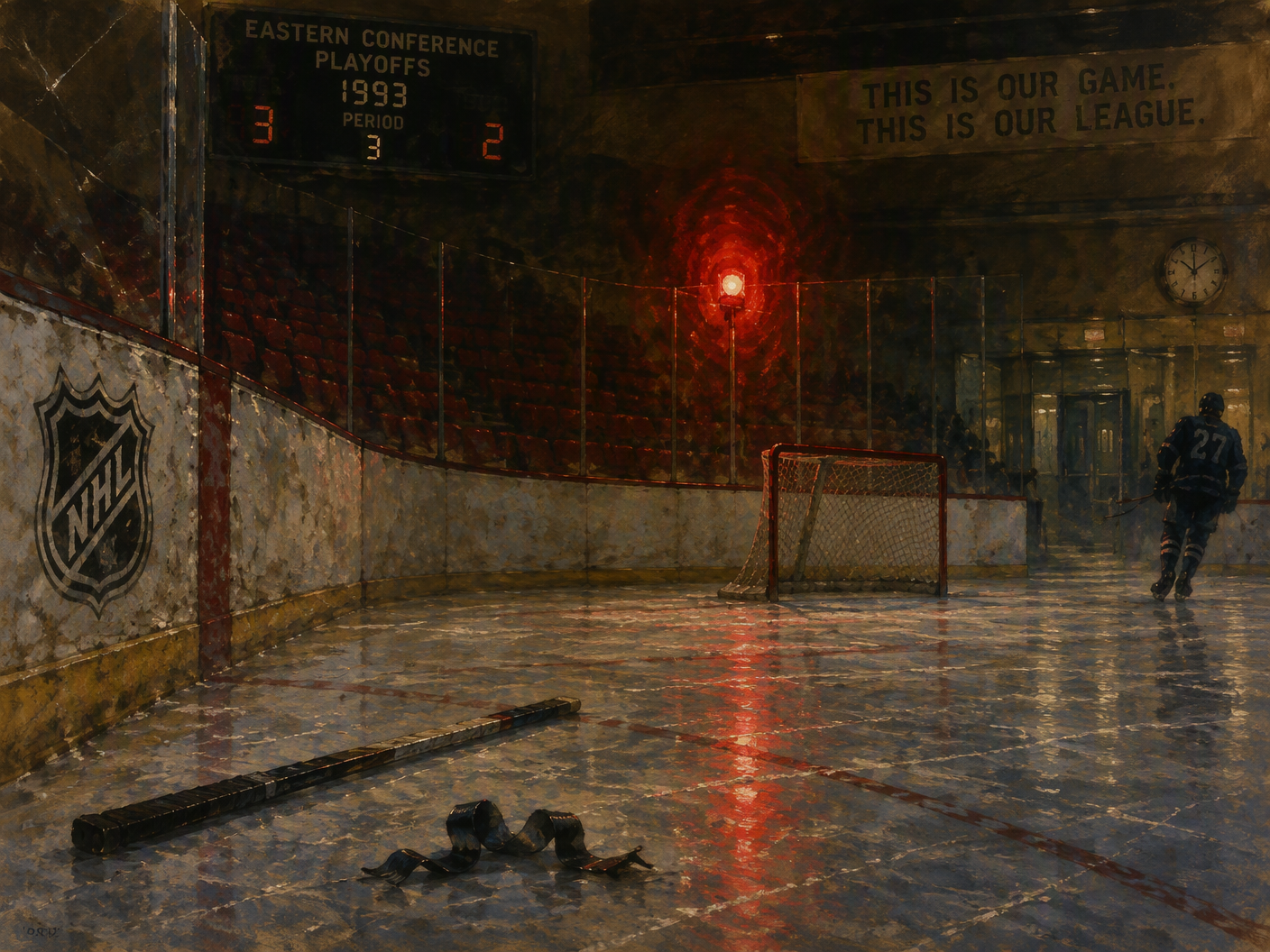
The goal had gone in. Pierre Turgeon had done the work that ends a playoff series: the finish, the release, the red light burning over the Capital Centre ice. Then Dale Hunter arrived after the play. His hit caught Turgeon and damaged the Islanders forward’s shoulder. The celebration broke against the boards and turned into something colder. Turgeon had scored the goal that sent New York onward. Hunter had supplied the last collision, late enough to become the night’s second headline.
It was April 28, 1993, in Landover, Maryland. The Capital Centre carried the usual playoff weather—ice glare, damp wool, leather tape, the hard scrape of skates and sticks against the rink. Hockey gives violence a schedule and a uniform. A player is expected to finish a check, answer a check, absorb the pain, and return to the shift. Hunter’s contact came after Turgeon’s scoring play, when the contest had already been decided in the most important sense. Timing made the collision impossible to separate from the goal.
Turgeon left the moment with a shoulder injury. The body keeps its own scoreboard. A shoulder can turn a stick into dead weight, a jersey into a restraint, a playoff victory into a medical problem. The Islanders had won the series-clinching moment; their scorer carried the consequence. Hunter’s hit did not erase Turgeon’s goal, but it changed the shape of the celebration around it. In the dressing rooms and corridors beneath the arena, the winning play and the injured player became one event.
Hunter was a Washington Capital built for the hard edge of the game. His reputation rested on physical play and aggression, the kind of currency that circulates quickly in a league where intimidation can be as useful as speed. The hit on Turgeon fixed that reputation in place. It gave his name a permanent attachment: the forward who struck after the decisive goal. A player’s public identity can be assembled from seasons of work, then sealed by one sequence of seconds.
The condemnation moved faster than any official timetable. The hit was widely denounced because it crossed the line between the violence of a live contest and the violence that arrives after the contest has turned. The Capitals and Islanders already carried their own old friction, and Hunter’s action added weight to it. Rivalries feed on memory. A check becomes a grievance; a grievance becomes a story told before the next puck drops. Turgeon’s shoulder gave that story a physical center.
The machinery of punishment did not operate on the ice. It waited in offices, under fluorescent light, where league officials converted a few violent seconds into a number. The NHL disciplinary process examined Hunter’s conduct and reached beyond the ordinary penalty of a game or a fine. The question was no longer how many minutes Hunter would spend in a box. It was how long the league would keep him away from the game itself.
In October 1993, NHL headquarters announced the answer: 21 games. The suspension covered the opening stretch of the 1993–94 season and imposed a cost that could not be absorbed as part of playoff contact. Hunter would miss games, work, and the nightly ceremony of being available when the sticks came up and the bodies closed in. The league made the punishment visible. The number stood in the public square like a cold brass plate.
Twenty-one games was more than a reprimand and less than exile. It was the NHL drawing a boundary around a moment it had allowed to become part of the sport’s grammar. The suspension carried its own contradiction. Hockey depended on players willing to operate near the limit, yet the league still needed a limit that could be seen. Hunter’s hit forced the office to define one after the fact, with Turgeon’s injury and the timing of the collision attached to every calculation.
Hunter’s supporters could point to the culture that had made him valuable: the pressure, the contact, the expectation that a Washington player would not retreat when a New York player crossed the ice. None of that changed the sequence. Turgeon scored. Hunter hit him late. Turgeon suffered a shoulder injury. The disciplinary action followed. The scene required no invented motive to carry its force. The choice was visible in the distance between the goal and the blow.
The aftermath settled into the rivalry like grit beneath a skate blade. Hunter’s actions contributed to continuing tension between Washington and New York, giving both sides another piece of evidence for the version of hockey they already believed in. To one side, aggression was a badge and retaliation a language. To the other, the hit was an assault on the boundary that kept competition from becoming punishment. The NHL’s 21-game answer did not dissolve that argument. It preserved it.
There was no need to turn Hunter into a secret architect of injury to understand what happened. The event became important through its plain sequence: a decisive goal, a late hit, a damaged shoulder, public condemnation, and a suspension that reached into the following season. Intent remained a question people could argue over in bars and press boxes. The consequence did not. Turgeon was hurt, Hunter was removed from the game for 21 contests, and the rivalry inherited another scar.
By the time the lights came up on the next season, Dale Hunter’s name carried two records at once. He was the player Washington sent into the rough places, the physical forward whose aggression had made him a recognizable figure. He was also the man suspended for what happened after Pierre Turgeon scored. The league had tried to answer the hit with a number. The number followed Hunter onto the ice, where every late arrival and every raised shoulder now carried the memory of April 28.
Companion notes
Dale Hunter's Late Hit on Pierre Turgeon and its Aftermath
The official record establishes a significant incident that resulted in a long suspension and legal scrutiny of Dale Hunter following his hit on Pierre Turgeon during the 1993 NHL playoffs.
The Paper Trail & Official Records
On April 28, 1993, during Game 6 of the NHL playoffs at the Capital Centre in Landover, Maryland, Dale Hunter delivered a late hit on Pierre Turgeon just after Turgeon had scored a series-clinching goal for the New York Islanders. This moment was documented in various media reports as a pivotal event of the match, with outlets like The Washington Post analyzing the implications of the hit, which resulted in a shoulder injury for Turgeon, further investigated in municipal and league disciplinary records. The ensuing controversy surrounding Hunter’s actions has been deeply archived, illustrating both the personal and competitive tensions inherent in the Capitals-Islanders rivalry, as noted by the Wikipedia entry on the Capitals-Islanders rivalry, which provides context to the longstanding animosity between the two clubs. The collection of press dispatches and official league statements collectively build a substantial paper trail regarding the incident and the parameters of its fallout. [S1], [S2], [S4]
Forensic Chronology & Turning Points
Following the hit on Turgeon, the NHL's disciplinary board quickly took action. By October 1993, Dale Hunter was handed a significant suspension of 21 games, which was one of the longest in NHL history at the time. This suspension, confirmed in documents from NHL headquarters, was intended to address the severity of the incident and serve as a deterrent against such aggressive play. The official timeline reveals key turning points, suggesting that the case became a benchmark moment for the league's enforcement of player safety rules and disciplinary actions. The widespread condemnation from fans, players, and commentators following the hit illustrated the impact Hunter's behavior had not only on the players involved but also on the broader culture of NHL gameplay, marking a critical evolution in discussions about violence in professional sports. [S1], [S2]
Evidentiary Boundaries & Negative Findings
While the evidence clearly establishes that Dale Hunter was suspended for the start of the 1993-94 NHL season due to his actions against Pierre Turgeon, some aspects surrounding the incident remain contentious. The league documents affirm that the hit resulted in significant injuries for Turgeon, but allegations of Hunter's premeditated intent to injure remain unproven according to the official findings. Furthermore, claims suggesting that the incident singularly defined the intense rivalry between the Capitals and the Islanders have been dismissed in more recent analyses, indicating a more complicated history that encompasses various confrontations and disputes beyond just this one event. Overall, the evidentiary boundaries delineate clear documentation of Hunter's punishment while differentiating demonstrable facts from speculative narratives. [S1], [S2], [S5]
Source key
The associated evidence packet contains visible source URLs, source roles and the complete claim ledger.