
Scandals & Feuds · 2018
The Brooklyn Bus Attack and the 2024 Dublin Civil Liability Verdict
Conor McGregor’s 2018 attack on a bus outside Barclays Center led to New York criminal charges and a guilty plea to disorderly conduct. In November 2024, an Irish civil jury found him liable for sexually assaulting a woman in a 2018 Dublin hotel case and awarded approximately €260,000 in damages; the finding was civil, not a criminal conviction.
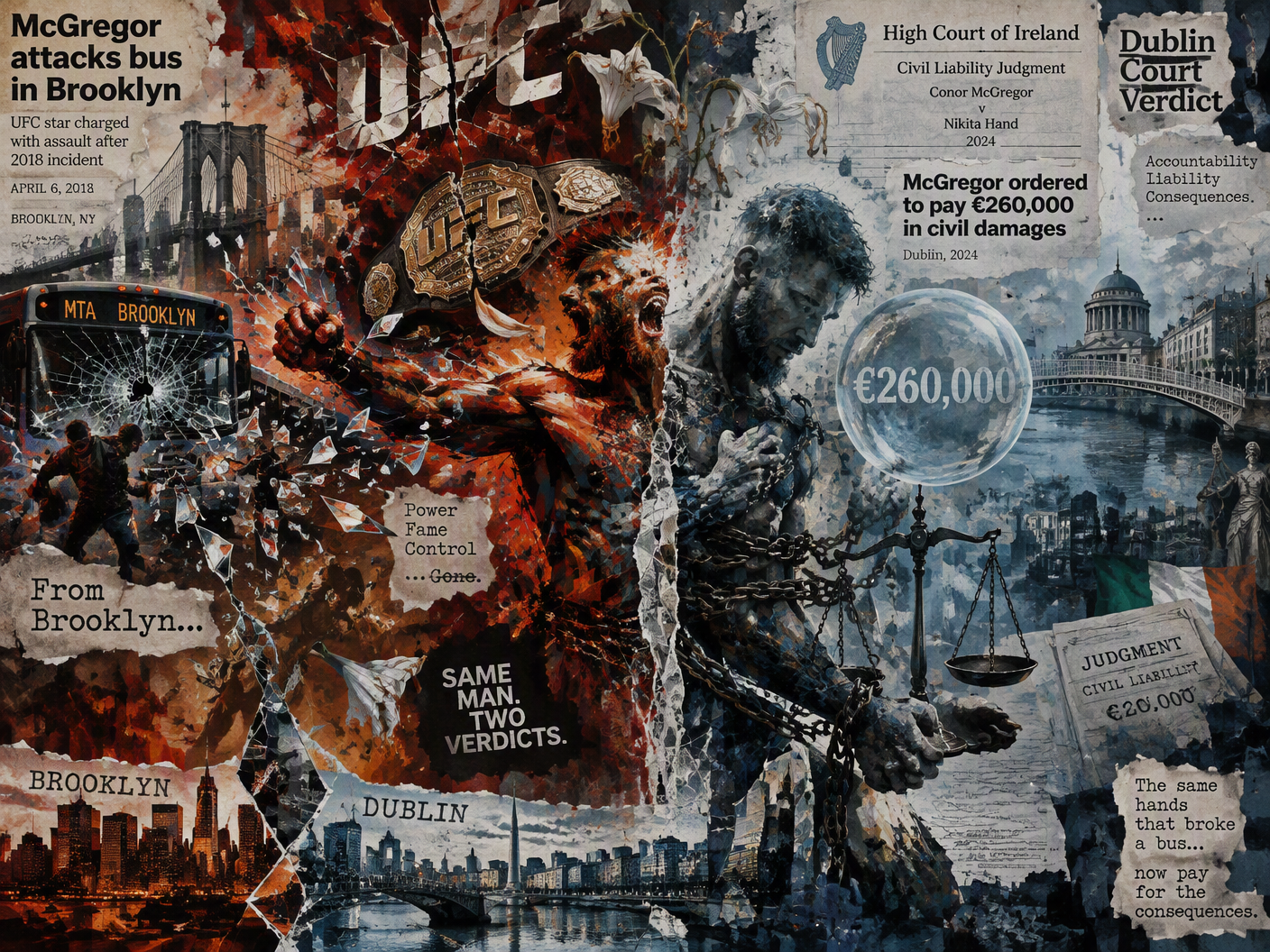
McGregor came to Barclays Center with an entourage, found a bus carrying UFC fighters, and threw objects at it. Glass broke. Michael Chiesa and Ray Borg were injured. The attack took place during the UFC 223 fight week in Brooklyn, where a promotion built on controlled violence had briefly lost control of the street. Police charged McGregor with assault and criminal mischief. The event lasted minutes. Its legal shadow stayed longer.
The bus held fighters preparing for a card already strained by an altercation involving Khabib Nurmagomedov and Artem Lobov. McGregor arrived after that dispute, and the confrontation moved from talk to broken glass. Chiesa, a fighter, was hurt inside the bus. Borg was hurt as well. The injuries disrupted the event and forced changes to the fight lineup. For the people inside the vehicle, the distinction between promotional hostility and physical danger ended when the windows gave way.
McGregor’s public identity had always depended on making himself larger than the room: the champion, the spokesman, the man who could turn an insult into an event. Outside the arena, that appetite met New York criminal law. Assault and criminal mischief charges followed. The charges named conduct, not mythology. They did not transform the bus attack into a proven conspiracy or establish a motive beyond the incident itself. The case narrowed quickly from spectacle to a question of what McGregor would accept in court.
On July 26, 2018, McGregor entered Brooklyn Supreme Court and pleaded guilty to disorderly conduct. There was no criminal trial on the bus attack. The plea disposed of the case through an agreement rather than a verdict after testimony. Cian Cowley, McGregor’s associate and co-defendant, also pleaded guilty. Their shared legal path moved the episode out of the arena and into the quieter arithmetic of conditions, appearances, and obligations.
McGregor avoided jail. The agreement required him to complete five days of community service and undergo an anger-management evaluation or program. Those terms were modest beside the force of the original scene: a star fighter, a bus full of colleagues, shattered glass, and police charges in Brooklyn. But the conditions put a named demand on the behavior. The court did not ask for another performance. It required time given away and an examination of anger.
The Brooklyn case ended there. Chiesa and Borg carried the immediate consequences of the broken windows, while the promotion carried the practical damage of a disrupted fight card. McGregor carried a guilty plea that resolved the New York charges without a criminal conviction on assault or criminal mischief. That distinction belongs to the event itself. A plea to disorderly conduct is not the same legal outcome as a trial verdict on the original charges.
Six years later, another case reached an Irish courtroom. It concerned a 2018 incident in a Dublin hotel and a civil claim brought by Nikita Hand. The setting had changed from an arena district in Brooklyn to a hotel case in Ireland. The legal question changed with it. This was not a criminal prosecution. It was a civil action in which a jury assessed liability and damages arising from the alleged sexual assault.
At the conclusion of the Dublin civil trial in November 2024, the Irish jury found McGregor liable for sexually assaulting Hand and awarded approximately €260,000 in damages. McGregor was not criminally convicted in that proceeding. The judgment carried civil consequences: money owed, public liability fixed by a jury, and a separate legal record attached to the same public figure who had already pleaded guilty in New York.
The two episodes are often pulled together because McGregor is the common name in both. They remain different cases. Brooklyn produced police charges and a negotiated guilty plea to disorderly conduct. Dublin produced a civil jury’s finding of liability and an award of damages. Neither outcome supplies facts that belong only to the other. The bus attack does not prove a larger criminal plot. The Irish verdict is not a criminal conviction. The law kept the files in separate rooms.
What joins the cases is not a single legal theory but a pattern of consequence following conduct under pressure. In Brooklyn, an object thrown at a bus became injuries, charges, and court-ordered conditions. In Dublin, a civil claim became a jury finding and a financial award. The public image could absorb both events as headlines. The people involved had to absorb them as injuries, litigation, obligations, and judgment. On the Brooklyn file, the final requirement was five days of service and anger management. In Ireland, the number attached to the judgment was about €260,000.
Investigative Dossier & Evidence
Read the companion investigation notes, verified source claims, and primary documents.
Read the Companion Notes & Evidence Record →