
Scandals & Feuds · 1973
The Injury Document Charlie Finley Used Against Mike Andrews
After Mike Andrews made two 12th-inning errors in Game 2 of the 1973 World Series, Oakland owner Charlie Finley required him to sign an injury-related document. Commissioner Bowie Kuhn reversed the move, restoring Andrews to the roster before he appeared as a pinch-hitter in Game 4.
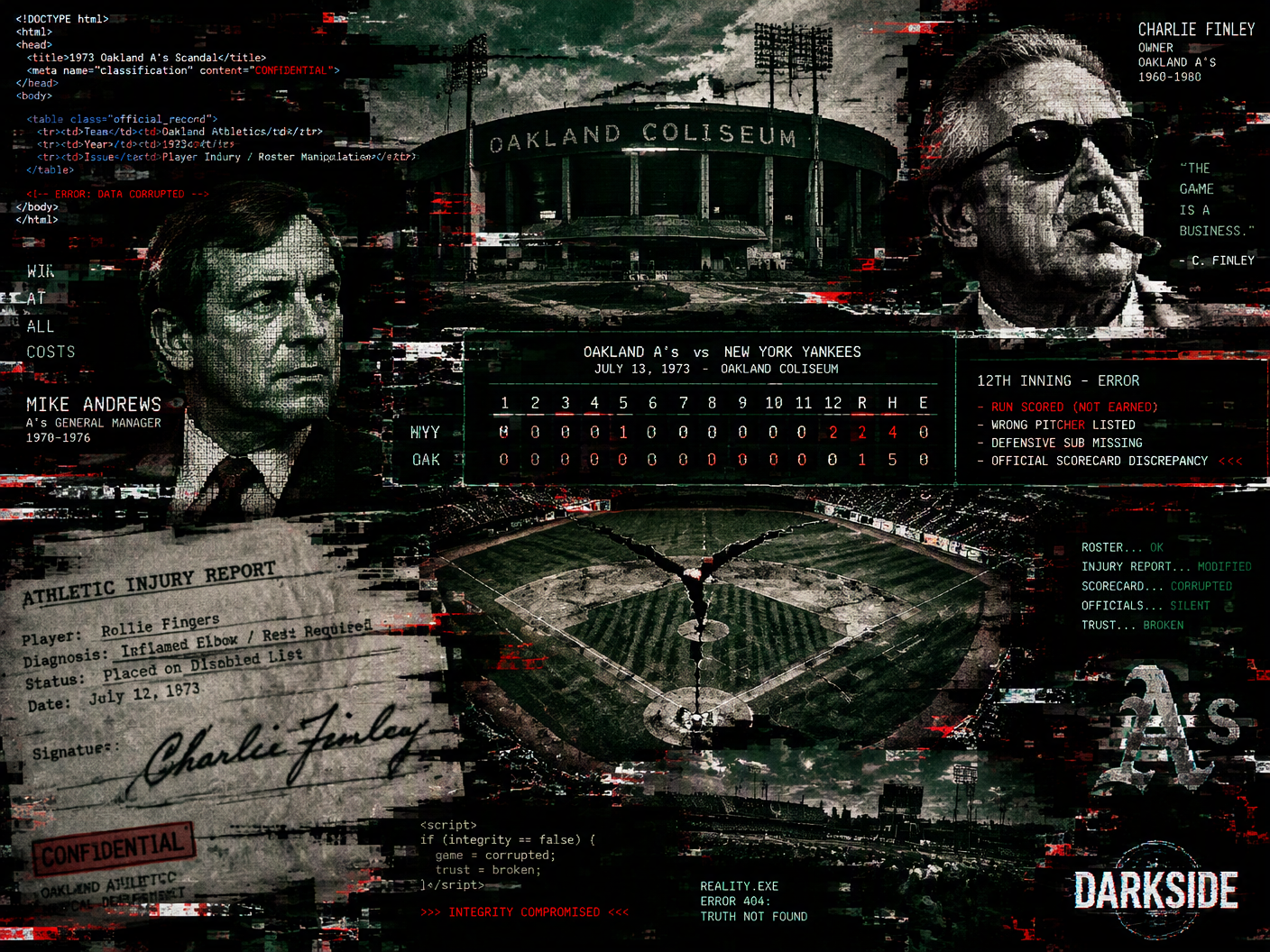
On October 14, 1973, at the Oakland-Alameda County Coliseum, the result of a World Series game became an administrative confrontation. Mike Andrews, Oakland’s second baseman, committed two errors in the 12th inning of Game 2. The New York Mets won, 10-7. Afterward, Charlie Finley required Andrews to sign a document describing him as injured or placed on the disabled list. The decision changed Andrews’s status before the Series had ended. It also brought the club owner’s authority into direct conflict with the commissioner who governed Major League Baseball.
Andrews had entered the Series not as a reserve attached to the margins of Oakland’s roster but as the Athletics’ second baseman. His position placed him at the center of every ground ball moving through the right side of the infield, and in Game 2 his name became attached to two errors in the final inning. The Mets’ 10-7 victory gave the mistake a measurable consequence in the standings of the Series. Whatever had been decided during the game, the postgame action moved beyond ordinary lineup judgment: a player’s availability was recast as a medical matter.
The signing occurred immediately after the game in the Oakland clubhouse. Finley was the owner, and Andrews was required to put his name on the injury-related paper while the club physician, Dr. Harry Walker, was involved in the medical examination and the circumstances surrounding the document. The paper characterized Andrews as injured or going onto the disabled list. It did not function merely as an explanation for a manager’s decision to sit a player. It supplied an official description of why a World Series participant would no longer occupy his place on the roster.
The timing fixed the document to the loss. Andrews’s errors had occurred in the 12th inning; the injury designation followed in the clubhouse. Between those two events, the Athletics had moved from a defeat on the field to an attempt to alter the personnel available for the remaining games. Finley controlled the club’s ownership and roster decisions as he understood them. The commissioner controlled the league’s governing authority. Their competing positions were now attached to one player’s signature and to the question of whether that signature could remove him from the Series.
By October 15, the matter had left the private space of the postgame clubhouse. Bowie Kuhn, Major League Baseball’s commissioner, forced Finley to reinstate Andrews. The intervention restored Andrews to the Athletics’ roster during the ongoing World Series. Kuhn’s action established a boundary around an owner’s power: Finley could direct the club, but the league office could reject the status he had imposed when that status affected the integrity of the championship itself.
The reversal did not erase the signing or return the Series to the moment before Game 2. Andrews remained the player whose two errors had preceded the disputed designation, and Finley remained the owner who had required the document. What changed was his formal availability. The commissioner’s order converted a player who had been removed through an injury-related classification back into a member of the active Oakland group. The dispute therefore produced two official acts in sequence: Finley’s attempted removal and Kuhn’s compelled restoration.
Dick Williams, Oakland’s manager, supported Andrews publicly during the dispute. Teammates displayed Andrews’s number in an act of solidarity, giving the episode a visible clubhouse dimension without changing its formal structure. The relevant authority still ran through the owner, the physician’s involvement, and the commissioner’s ruling. Andrews’s position was not settled by sentiment or by the public posture of the club. It was settled, temporarily, by Kuhn’s decision to place him back where he could legally participate.
Andrews did participate again. In Game 4 of the 1973 World Series, he appeared as a pinch-hitter. The appearance was limited, but its meaning within the sequence was exact: the player Finley had sought to classify as unavailable was back in uniform and eligible to enter the game. The episode had not ended with the paper signed after Game 2. It had continued through the commissioner’s intervention and reached the field again, where Andrews’s role was no longer that of starting second baseman but was not yet absence.
The restoration lasted through the Series, not through Andrews’s relationship with Oakland. On November 1, 1973, the Athletics gave him his unconditional release. That transaction came after the immediate dispute had been resolved and placed a final administrative boundary around the episode. The World Series had produced the errors, the injury-related document, the commissioner’s reversal, and the pinch-hitting appearance. The release supplied the next institutional fact: Andrews remained connected to the club only until Oakland formally ended the association.
Later retellings can compress the episode into a story about an owner punishing a player for a costly mistake. The documented sequence is narrower and stronger. Andrews played second base for Oakland; he made two 12th-inning errors in a 10-7 loss to the Mets; Finley required an injury-related signing; Kuhn forced the owner to reinstate him; and Andrews pinch-hit in Game 4. Those actions survive as the enduring structure of the affair. The paper’s power came from what it could do to a roster, and its limit came from a commissioner who refused to let it stand.
Investigative Dossier & Evidence
Read the companion investigation notes, verified source claims, and primary documents.
Read the Companion Notes & Evidence Record →