
Match-Fixing & Monopoly Power · 1919–1921
The Black Sox Case and the Commissioner’s Contractual Claim to Final Authority
The 1920–1921 record separates criminal acquittal from baseball’s private discipline. It also shows how the reserve clause and the January 1921 Major League Agreement placed players inside institutions that could restrict their labor and impose final administrative decisions.
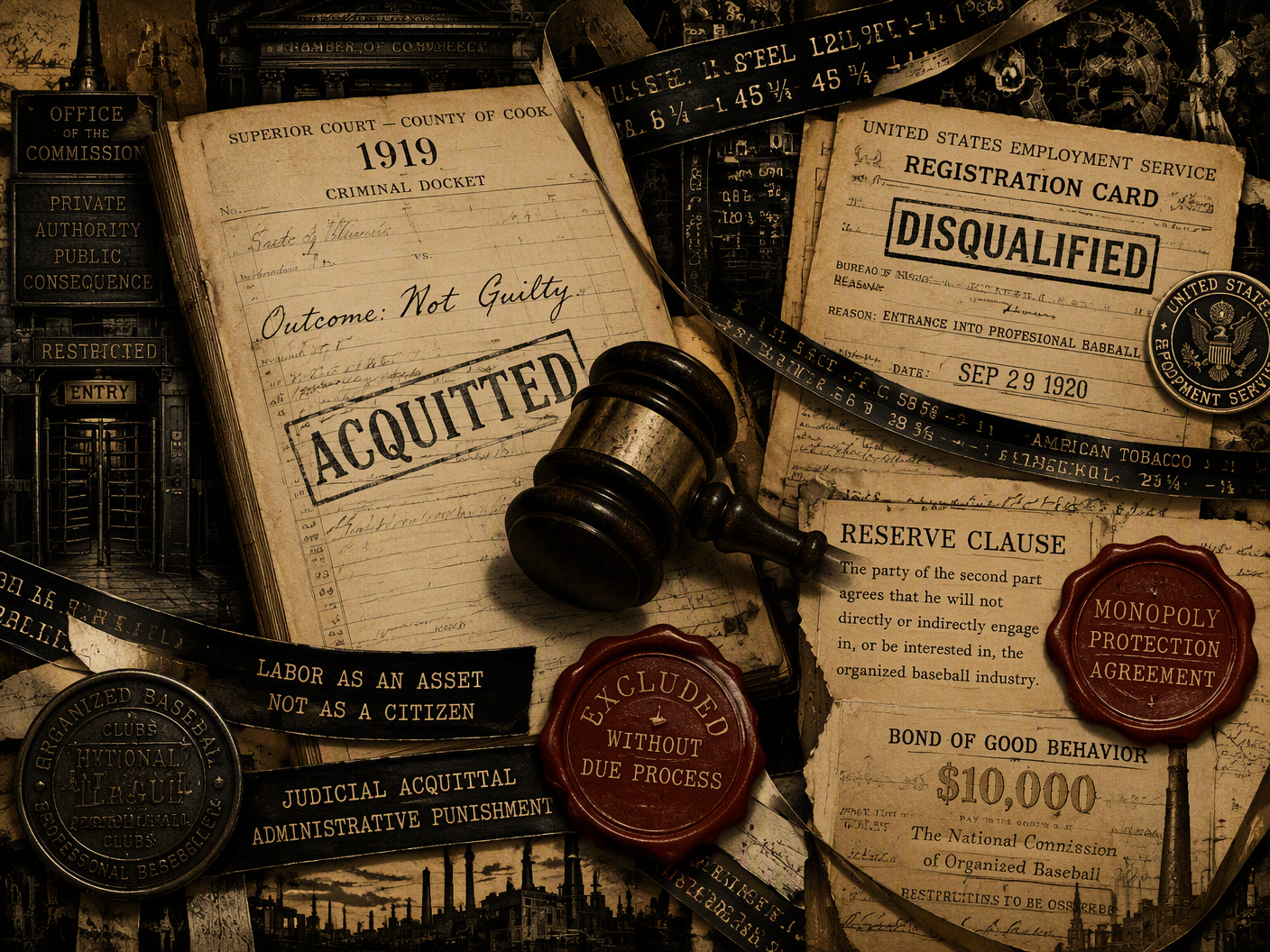
In September 1920, a Cook County special grand jury opened an inquiry into allegations that eight White Sox players had conspired with gamblers to intentionally lose the 1919 World Series. The inquiry was a criminal proceeding, built around accusations of conspiracy and fraud. Its existence establishes that the allegations were investigated; it does not, by itself, establish that the alleged fix was proved beyond the criminal proceeding. That distinction would become central when the courtroom record and baseball’s private authority moved along separate tracks.
The grand-jury materials included reported sworn confessions from Eddie Cicotte and Shoeless Joe Jackson. According to the Cook County record, both signed statements saying they had received money to participate in the alleged fix. But the same account preserves the weaknesses that followed those documents: the original confessions disappeared, the defendants later recanted, and unsigned transcript copies were ruled inadmissible without proof that the statements had been made voluntarily. The record therefore contains both an account of confession and a procedural limit on using it.
Those evidentiary complications belonged to the criminal case, where the defendants faced conspiracy-to-commit-confidence-game and fraud charges. The Cook County account states that the jury found all eight players not guilty on all counts. A New York Times account describes the verdict differently, referring to seven players and two gamblers, a discrepancy in the published record that should not be erased. The direct Cook County account supports the acquittal of all eight players; the competing report makes the precise description of the verdict part of the record’s limitation.
An acquittal answered the criminal charges before the jury. It did not, on the verified record, decide every question that baseball’s governing institutions might put to players under their own agreements. That is not a declaration that the alleged conduct occurred, nor a finding that the players were responsible for every act later described by the commissioner. It is a separation of forums: the criminal court reached acquittals, while the sport’s private administration operated under a written agreement that claimed a different and broader decision-making power.
The labor structure surrounding those proceedings was already restrictive. An archival summary of 1918–1919 White Sox contracts describes the reserve clause as an exclusive perpetual option held by clubs over players’ services. The clause limited players’ ability to negotiate with other clubs and barred them from entering a free market, according to the summary. That description is not a reproduced contract text or a court ruling, and its broader claims about wages, blacklisting, and owner power are not adjudicated findings. Still, it documents a durable institutional limit on player choice.
The same archival material places two players’ 1919 pay in that structure. It states that Eddie Cicotte was paid $6,000 and Claude Williams $2,600. It also states that Cicotte approached Comiskey about an agreed $10,000 bonus for winning 30 games, after which Comiskey had Cicotte benched for the final two weeks of the 1919 regular season. The source does not characterize the matter as a bonus dispute. Its value here is narrower: it records the figures, the approach, and the benching as described in the archival summary.
While the criminal process was unfolding, baseball altered its central governing mechanism. The Major League Agreement of January 12, 1921, as summarized by an MLB-hosted source, abolished the three-man commission and created a single commissioner. It authorized that commissioner to investigate conduct charged, alleged, or suspected to be detrimental to baseball’s best interests. The agreement thus placed allegations—not only conduct established in a criminal court—within the stated reach of the new office. The source presents the agreement’s terms but does not independently authenticate the full document.
The agreement went further in describing the commissioner’s decisions as final and unappealable. It stated that no club, league, or player could resort to court to contest an action or decision. That is contractual language in the published record, not proof of how every court later interpreted or enforced it. But its institutional design is clear enough to state precisely: the agreement sought to make the commissioner’s decision the endpoint inside baseball, while restricting the parties’ ability to challenge that decision in court.
After the criminal verdicts, the New York Times reported that Kenesaw Mountain Landis announced lifetime bans for all eight White Sox players. The report placed the announcement shortly after the verdicts, creating the defining contrast in the case’s procedural sequence: acquittal in the criminal court, followed by unilateral administrative punishment from the commissioner. The captured material does not include the complete disciplinary order or a separate official ban record. The bans are therefore established here as a contemporaneous newspaper report, not as a fully reproduced administrative file.
The statement attributed to Landis also described the conduct he said would disqualify players from professional baseball. The New York Times reported that players who threw games, undertook or promised to throw games, or attended discussions of throwing games and failed promptly to inform their club would not play professional baseball. That reported statement describes categories of conduct; it does not establish that every banned player committed each category. Its importance lies in the rule’s breadth: knowledge and failure to report were included alongside participation or promises.
Taken together, the documents show two kinds of authority operating beside one another. The criminal jury’s acquittals did not become a command that the commissioner accept the same result for baseball’s private discipline. The January agreement claimed final, unappealable power. Separately, the newspaper reported that Landis announced lifetime bans after the verdicts. At the same time, the record does not prove the alleged conspiracy beyond the criminal proceeding, does not supply the complete ban order, and does not establish how courts would enforce every clause.
The reserve clause gives that machinery a labor dimension. Clubs’ ongoing exclusive option over services limited players’ ability to seek other clubs, while the commissioner agreement concentrated investigative and disciplinary authority in one office. The verified record does not establish that the arrangement protected cartel profits, and it does not independently authenticate every institutional consequence. It does establish a system in which players’ access to competing employment was described as restricted and in which a reported lifetime ban could close professional baseball to the players named by the commissioner.
Companion notes
What Acquittal Could Not Prevent
The record places a criminal jury, a private governing agreement, and a commissioner’s reported bans in the same chronology. Their powers and evidentiary standards must not be treated as interchangeable.
The grand jury and the disputed confession record
The Cook County Circuit Court archive documents the September 1920 special grand-jury investigation. It establishes the allegations that eight White Sox players conspired with gamblers to intentionally lose the 1919 World Series. It also reports sworn grand-jury confessions signed by Eddie Cicotte and Shoeless Joe Jackson, stating that they received money to participate in the alleged fix. The archive’s own limitations are material: the original confessions disappeared, the defendants later recanted, and unsigned transcript copies were ruled inadmissible without proof of voluntariness. [Source 1]
Those qualifications prevent the investigation from converting an allegation or reported confession into a finding that the conspiracy was proved beyond the criminal proceeding. The source documents the inquiry and the evidentiary path described in the record, not a completed proof of guilt independent of the trial’s outcome. The grand-jury material is therefore strongest for chronology and procedural history, while its account of the confessions must remain attributed and bounded. [Source 1]
The criminal verdict and its boundary
The Cook County account states that the criminal jury acquitted all eight players on all counts of conspiracy to commit confidence game and fraud. The New York Times account captured in the source set describes the verdict differently, referring to seven players and two gamblers. That discrepancy does not erase the direct Cook County statement, but it requires precise wording about the captured record rather than an unsupported reconciliation. The secure conclusion is that the criminal proceedings ended in acquittals, with the sources differing in their description of who was included. [Source 1], [Source 4]
Legally and institutionally, the acquittal must remain distinct from later baseball discipline. The sources establish a criminal jury’s verdict; they do not establish that the jury’s reasoning resolved every private disciplinary question, nor that the alleged conspiracy was proved outside the criminal proceeding. Any account of what followed must therefore avoid treating acquittal as a finding that no underlying conduct occurred, while also avoiding the opposite error of treating allegations as adjudicated guilt. [Source 1], [Source 4]
The reserve clause as labor machinery
The Library of Congress archival summary describes the reserve clause in 1918–1919 player contracts as an exclusive perpetual option held by clubs over players’ services. It says the clause limited players’ ability to negotiate with other clubs and prohibited entry into a free market. This is archival description, not reproduced contract language or a court ruling. The source’s broader descriptions of wages, blacklisting, and owner power are likewise outside what can be treated as adjudicated findings. [Source 3]
The same summary records that Eddie Cicotte was paid $6,000 and Claude Williams $2,600 in 1919. It says Cicotte approached Comiskey about an agreed $10,000 bonus for winning 30 games and that Comiskey had him benched for the final two weeks of the regular season. The source does not call this a bonus dispute. These details establish documented terms and actions in the archival account, but not a proven motive or a broader financial conclusion. [Source 3]
The commissioner agreement and reported bans
An MLB-hosted summary of the January 12, 1921 Major League Agreement states that the three-man commission was abolished and replaced by a single commissioner. It describes authority to investigate conduct charged, alleged, or suspected to be detrimental to baseball’s best interests. It also quotes provisions making the commissioner’s decisions final and unappealable and barring clubs, leagues, and players from resorting to court to contest an action or decision. The captured material does not independently authenticate the full agreement or establish how every court interpreted it. [Source 2]
The New York Times is the source for the reported disciplinary outcome. It said Landis announced lifetime bans for all eight White Sox players shortly after the criminal verdicts and reported his statement that players who threw or promised to throw games, or who learned of plans and failed to report them, would not play professional baseball. The newspaper report does not supply the complete disciplinary order or prove that every banned player committed every conduct category described. It establishes the reported timing, scope, and wording of the commissioner’s action. [Source 4]
Source key
The associated evidence packet contains visible source URLs, source roles and the complete claim ledger.